

Why Genetic Testing Matters: Illustrated with Clinical Evidence
June 07, 2026
In hematological malignancies, genetic testing drives precision diagnosis, prognostic stratification, individualized treatment, and MRD monitoring for relapse.
Hematology Special Testing
Many public figures have undergone genetic testing, including Sergey Brin (co-founder of Google), Steve Jobs (co-founder of Apple), and singer G.E.M. Why do they choose it? Tests for gene mutations, hereditary susceptibility genes, and drug-metabolizing genes play an irreplaceable role in the diagnosis and treatment of hematological malignancies. Below, we break down the core value of genetic testing with clinical evidence.
1. Precision Diagnosis
Genetic testing delivers definitive diagnoses. Hematological diseases often share similar clinical manifestations, while the same disease can present very differently. A rapidly deteriorating condition may be benign, whereas a slow-progressing one could be malignant — this is where genetic testing proves critical.
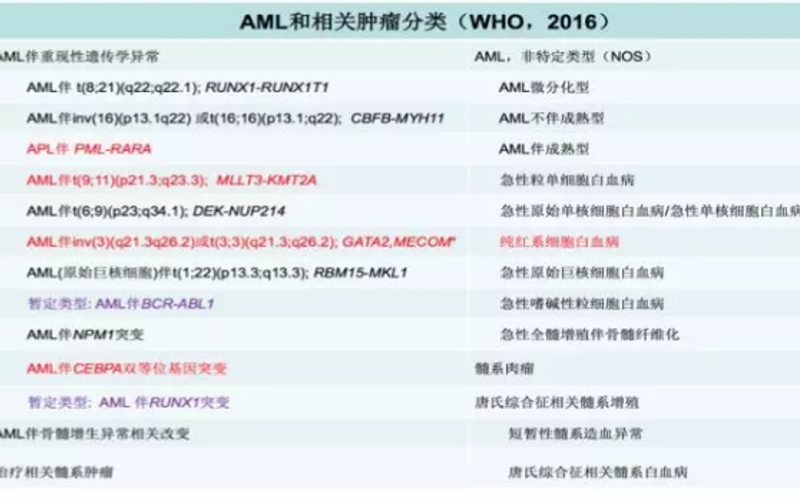
Take Acute Myeloid Leukemia (AML) as an example, referencing the 2016 WHO Classification of Tumours of Haematopoietic and Lymphoid Tissues. The italicized gene symbols in the classification represent distinct genetic markers, which are core criteria for disease subtyping. Beyond the WHO standards, major guidelines such as the NCCN Guidelines and domestic expert consensus integrate gene mutations into refined subtyping. The 2019 NCCN AML Guidelines explicitly recommend routine gene mutation screening for all AML patients, and an increasing number of leukemia subtypes are defined solely by genetic profiles. Genetic testing has become a standard, first-line procedure for oncology care — only with an accurate molecular diagnosis can clinicians formulate targeted regimens.
2. Prognostic Stratification
Chemotherapy, targeted therapy, and hematopoietic stem cell transplantation remain primary AML treatments. AML patients exhibit extreme heterogeneity in clinical performance and outcomes, so pre-treatment risk stratification is essential. In recent years, genome sequencing has supplied abundant molecular biomarkers for prognostic stratification. The 2017 European LeukemiaNet (ELN) risk stratification system for AML clearly demonstrates that different gene mutations correspond to vastly different prognosis levels — favorable, intermediate, or adverse.
3. Guiding Individualized Treatment
Deeper understanding of leukemic genetic variants enables more precise therapy. AML comprises dozens of distinct molecular subtypes, and treatment differs drastically between them — even within one subtype, disparate mutation sites alter drug response. For example, genetic profiling determines whether Imatinib or Dasatinib is the appropriate therapy, as validated in the New England Journal of Medicine (NEJM, 2013;368:1781-90). Chemotherapy efficacy and toxicity also vary widely due to inherited differences in drug metabolism. Many agents for blood cancers rely on genetic metabolic pathways: L-asparaginase for ALL induction, 6-Mercaptopurine (6-MP) and Methotrexate (MTX) for ALL maintenance, and Cytarabine for standard chemotherapy. Testing for drug-metabolizing polymorphisms predicts drug efficacy and adverse reactions, laying the foundation for personalized precision oncology.
4. Minimal Residual Disease Monitoring for Relapse Surveillance
Genetic testing detects minimal residual disease (MRD) to monitor early relapse risk.
Summary
Genetic testing enables precise diagnosis, prognostic risk assessment, and customized targeted therapy, significantly improving overall survival rates for hematological malignancies.
Related Images