
What Does the Prostate Do, and How to Manage Prostate Hyperplasia
November 20, 2025
Frequent night urination, weak stream and incomplete voiding in men over 40 are often benign prostatic hyperplasia (BPH), not just aging or kidney weakness.
Many men in their forties and fifties notice changes: frequent nighttime bathroom trips, standing a long time before urination starts, and a constant sense of incomplete voiding. Many dismiss these as kidney deficiency or inevitable aging, but such discomfort is most likely linked to the prostate.
Where the Prostate Is Located
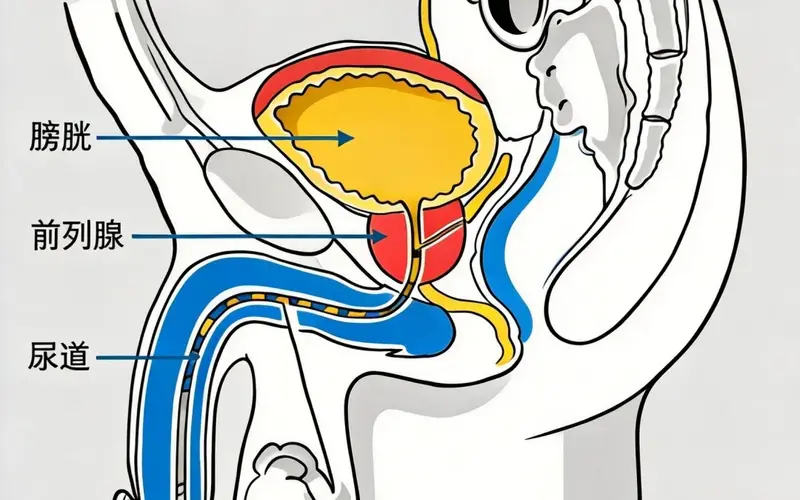
A healthy prostate is about the size and shape of a chestnut. It sits directly beneath the bladder and wraps around the start of the urethra like a ring. The bladder stores urine and the urethra carries it out. The prostate acts as a gatekeeper at the bladder outlet: at normal size urine flows smoothly, but if it swells (benign prostatic hyperplasia, BPH) it compresses the urethra and makes urination difficult.
Functions of the Prostate
Prostatic fluid secreted by the prostate is a vital part of semen, nourishing sperm and providing a medium for their movement. Surrounding the urethra, the prostate's smooth muscles and sphincters also help regulate urine discharge. Once the prostate malfunctions, quality of life drops sharply.
Why the Prostate Is Prone to Hyperplasia
Prostate hyperplasia is not strictly a disease but a natural sign of aging. Prostate growth is regulated mainly by androgens (testosterone); as people age, hormonal balance shifts and the prostate slowly enlarges. Nearly all men will develop some degree of hyperplasia if they live long enough.
Typical Symptoms of BPH
- Frequent urination: over 8 daytime trips, more than 2 nighttime awakenings
- Urgency: sudden, uncontrollable urges
- Hesitancy: long waits before the stream starts
- Weak, narrow stream
- Post-void dribbling / incomplete emptying
- Intermittent stream that cuts off before resuming
Combined, these greatly impair daily life. Some seniors suffer falls and fractures from nighttime trips; others avoid outings for fear of not finding a restroom, leading to social isolation.
These symptoms do not always mean BPH. Urethral stricture, bladder neck contracture, neurogenic bladder and bladder cancer can mimic it. Do not self-diagnose or endure the pain silently, visit a hospital for professional examination.
Treatment Options
Physicians select treatment based on symptom severity, prostate size, and overall condition, across three categories:
- Watchful waiting: for mild symptoms; adjust lifestyle, limit tea and coffee, avoid large fluid volumes before bed, and attend periodic checkups.
- Medication: first-line for disruptive symptoms; common prescriptions include tamsulosin and finasteride.
- Surgery: for patients who do not respond to medication or wish to avoid long-term drugs. Minimally invasive procedures are now standard, including transurethral resection, enucleation, urethral stenting, hydrostatic dilation, thermal steam ablation, and AI-HIFU ablation.
Related Images