
Recurrent Eczema in Children in Spring: How to Scientifically Protect Your Child's Skin
June 06, 2026
Spring's dry wind, temperature swings, and allergens make childhood eczema flare. A guide to why it happens, its stages, and safe skin-barrier care.
As temperatures rise and nature revives in spring, it is also a peak season for childhood eczema. A baby's skin is delicate; once eczema develops, itching, redness, and papules not only make the child fussy and cry, but also cause great anxiety for parents. Here are common questions about infant eczema to help children escape its troubles.
Why is childhood eczema so common in spring?
Childhood eczema is a chronic inflammatory skin disease closely related to skin barrier function and immune status. Its onset is linked to genetics, immunity, environment, and other factors. Spring's climatic and environmental characteristics act as a "catalyst" for flare-ups.
01 Genetic factors
Genetics form an important foundation. If parents have a history of atopic diseases such as eczema, allergic rhinitis, or asthma, the baby's risk of developing eczema increases significantly.
02 Immune factors
Most children with eczema have immune dysregulation. Their bodies produce excessive pruritogenic factors, making skin more prone to inflammation and itching.
03 Environmental factors
- Dry, windy spring weather with low humidity accelerates moisture loss from delicate skin, damaging the fragile barrier and letting irritants invade more easily.
- Large temperature fluctuations cause sweating and alternating vasoconstriction and dilation; sweat irritation worsens discomfort.
- A sharp increase in allergens such as pollen and dust mites easily triggers allergic reactions, inducing or worsening eczema.
Watch for symptoms in different stages
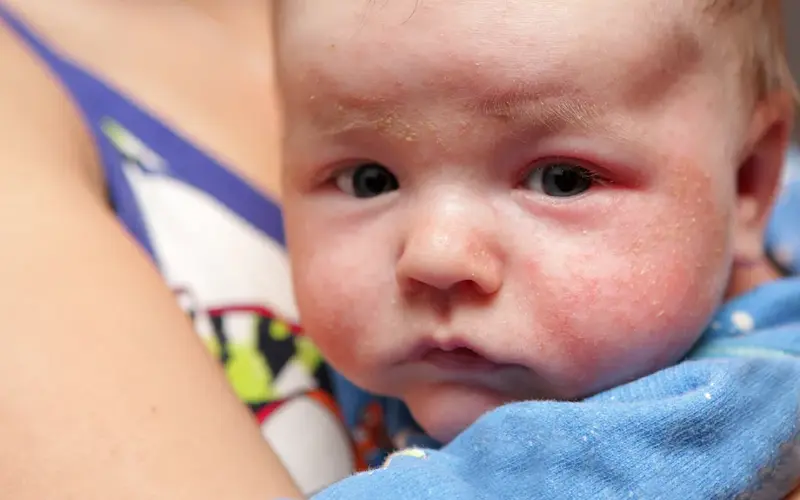
Childhood eczema often occurs on the cheeks, scalp, neck, and flexor sides of the limbs, showing different features at each stage.
01 Acute stage
- Blurred, irregular red macules (pale to bright red) appear, commonly on the cheeks.
- Dense papules and papulovesicles develop; tiny vesicles rupture easily from scratching, oozing pale yellow fluid that forms yellow crusts when dry.
- Severe itching is prominent, causing restlessness and crying; itching worsens at night and disturbs sleep.
02 Subacute stage
- Redness and swelling decrease significantly; erythema fades; oozing is greatly reduced; crusts dry and thin.
- A few papules remain with fine scales.
- Itching persists but is milder than in the acute phase.
03 Chronic stage
- Skin becomes thickened, rough, and lichenified (deepened, widened skin lines), sometimes with cracks; common on hands, elbows, and knees.
- Hyperpigmentation occurs, darker than surrounding normal skin.
- Itching recurs repeatedly, creating a vicious cycle of "itching–scratching–worsening itching."
When eczema flares, babies may also have sleep disturbance and irritability. If the skin is broken from scratching, bacterial infection may occur, with increased redness, swelling, and purulent discharge — parents must stay alert.
Scientific management: proper care is crucial
01 Basic care: repair the skin barrier
Scientific bathing:
- Bathe daily or every other day; water temperature 32–37°C; duration 5–10 minutes.
- Use hypoallergenic, non-irritating, weakly acidic products; avoid body wash on eczema lesions.
- Pat skin dry gently with a soft towel; apply moisturizer generously all over within 3–5 minutes while skin is slightly damp.
Moisturizing is the top priority:
- Apply generously and frequently; choose creams or lotions with repairing ingredients such as ceramides and shea butter.
- Reapply anytime skin feels dry.
Clothing:
- Choose loose, soft, pure cotton clothes; avoid irritating fabrics like wool and synthetic fibers.
- Adjust clothing to temperature to prevent overheating and sweating.
02 Environmental adjustment: avoid triggers
- Use a humidifier indoors in dry spring to keep humidity at 50%–60%.
- Keep rooms clean, ventilate regularly, wash and sun-dry bedding and toys often to reduce dust mites and pollen.
- Avoid areas with high pollen concentration outdoors; use a mask if necessary.
03 Dietary management: no blind food restriction
Blind restriction may cause malnutrition and hinder skin repair.
- If a food is suspected to worsen eczema, avoid it for 4–6 weeks under medical guidance and observe.
- Use allergy testing and food challenges to determine links scientifically; restrict only confirmed allergic foods.
Medication: use scientifically under medical guidance
Topical corticosteroids are commonly used for childhood eczema.
- Prefer low to mid potency steroids: 0.05% desonide cream (low), 0.1% mometasone furoate cream (mid).
- Short-term high potency steroids may be used for thick, lichenified skin; ultra-high potency is generally avoided in children.
- Only low to mid potency steroids are suitable for thin, delicate areas (face, neck, scrotum).
Do not stop steroids abruptly once symptoms improve; continue maintenance with moisturizers to prevent recurrence. If symptoms worsen after applying ointment, seek medical advice promptly to rule out drug allergy. Do not use "pure herbal creams" with unknown ingredients.
Warm reminder
Caring for childhood eczema is a long-term battle. Dry weather and large temperature differences in spring require patient, careful care from parents. If home care does not improve eczema or it worsens (extensive redness, increased oozing, skin infection), consult a pediatric dermatologist promptly for a personalized treatment plan — do not delay.
Related Images