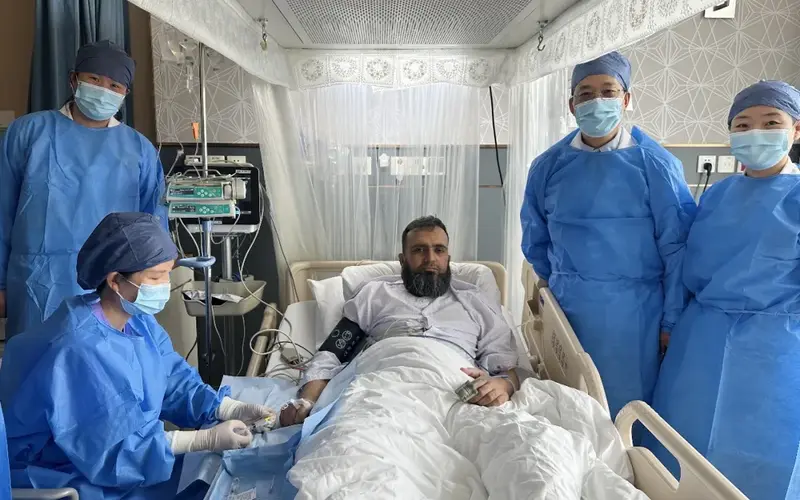
From Palliative Care to a Second Chance: A Pakistani DLBCL Patient's CAR-T Journey in China
June 09, 2026
After relapsed/refractory DLBCL left him with only palliative care in Pakistan, Muhammad found remission through CAR-T therapy at Jiahui International Cancer Center.
A Diagnosis That Changed Everything
For 36-year-old Muhammad ZAKRIA, the word "healthy" had become a distant memory. Muhammad works as a support staff member at a public hospital in Quetta, the capital of Pakistan's southwestern Balochistan province — a city often called the "Fruit Garden."
In 2021, his life changed with a single diagnosis: Diffuse Large B-Cell Lymphoma (DLBCL), an aggressive form of blood cancer. The years that followed were a punishing cycle of chemotherapy rounds and pain few could imagine enduring. In 2024, Muhammad underwent a bone marrow transplant at Aga Khan University Hospital in Pakistan, placing every hope in that surgery. But the cancer came back just 20 days later. Back home, his doctors could offer only one path: palliative care — no cure, just medication to ease the pain.
Part 1 — A Faint Light: Choosing Shanghai
After receiving the necessary approvals from Pakistan's National Medical Council, Muhammad began reaching out to hospitals across the globe — Germany, Singapore, Austria, India, the United States, and Australia.
- Germany replied slowly.
- Singapore and India sent back plans that felt unclear.
- One hospital replied quickly, with a clear communication style and a thoughtful initial treatment proposal.
Early in 2026, he and his family boarded a flight to Shanghai — exhausted, in pain, but still holding on to a single thread of hope.
Part 2 — CAR-T Therapy at Jiahui International Cancer Center
The scans confirmed the severity of Muhammad's condition: Stage 4B lymphoma, with cancer spread to his lungs, pleura, and bones. Because the disease had relapsed only 20 days after transplant, it was classified as "relapsed/refractory." A large tumor mass was pressing on his lungs and bones; only high-dose painkillers and strong sedatives offered brief relief. He also suffered persistent high fever, night sweats, and rapid weight loss.
Why China — and Why Now?
- According to a recent article in Frontiers in Pharmacology, China has been at the forefront of CAR-T research since 2016. As of October 2025, China ranks #1 globally in the number of CAR-T clinical trials.
- A separate study notes that since 2021, four domestically developed CAR-T products have been approved in China for lymphoma and multiple myeloma, with efficacy reaching global standards.
In short: when conventional medicine says "nothing more can be done," China often still has a next step.
The Treatment Plan
In early April, Muhammad began his multi-week CAR-T journey at Jiahui International Cancer Center, led by Dr. HAO Siguo (郝思国), Chief Hematology Specialist, with Dr. DONG Yan (董艳) as his primary attending physician:
1. T-cell collection — Muhammad's own T cells were harvested.
2. Bridging therapy — given the heavy tumor burden, Dr. Hao designed a personalized regimen combining chemotherapy and localized radiotherapy to shrink the tumor before reinfusion.
3. Lymphodepleting chemotherapy — to prepare the body for the modified cells.
4. CAR-T cell reinfusion.
By early May, the first PET-CT scans delivered encouraging results: lymph node lesions had visibly shrunk, tumor marker LDH had returned to normal, and pain that previously required high-dose sedatives was now manageable with just 2–3 low-dose pills every 12 hours, with no more "breakthrough pain." With his visa nearing expiration, the oncology team prepared a one-year follow-up plan and medication guide for his recovery back in Pakistan.
Part 3 — Care That Crosses Languages and Cultures
The Language Barrier
Muhammad's mother tongue is Urdu, and he does not speak English fluently. The Jiahui team used translation software to convert every important phrase into Urdu, fell back on gestures, eye contact, and patient repetition when the translator fell short, and wrote out every key instruction in plain text so he could re-translate at his own pace.
The Dietary Barrier
Muhammad's religious faith required halal preparation, and he asked for dry-cooked dishes with the best flavor and presentation. The catering team prepared customized halal meals — and he ate well throughout his stay, including six eggs a day, credited by his doctors as a meaningful boost to recovery.
The Emotional Side
Muhammad's youngest daughter became his anchor. Her voice on video calls — and one burger meal together during her visit — gave him motivation no medicine can manufacture. The team quietly made sure family video time was uninterrupted.
Part 4 — What He Carries Home
On May 8, Muhammad boarded his flight home. What he brings back is more than a stabilized scan and a one-year medication plan — it is the accumulation of every small kindness: a smile from a nurse who knew his name, a halal meal prepared with care, a doctor's patience in translating the same phrase three different ways, and body language that worked even when words did not.
Why This Story Matters for Patients Considering CAR-T Abroad
Every year, hundreds of patients from Pakistan, the Middle East, Central Asia, and Africa reach out to MedTourChina with the same story: "Our doctors say there's nothing more they can do." Often, that is not the final answer.
- Is CAR-T available for international patients? Yes — multiple Chinese hospitals accept international patients with proper medical visas and pre-screening.
- How long do I need to stay in China? Typically 4–8 weeks for collection, bridging therapy, reinfusion, and initial monitoring.
- What about language? Most top Chinese hospitals have dedicated international patient departments with English-speaking coordinators; a personal translator can be arranged for the entire stay.
- Can I continue treatment at home? Yes — coordination with your home oncologist plus full translated medical records and a one-year follow-up plan.
References
1. Wang M, et al. Global panoramic analysis of clinical research in cell therapy: clinical trial landscape, marketed products, and regulatory trends. *Frontiers in Pharmacology*, vol. 17, 2026.
2. Yan L, et al. CAR-T cell therapy in China: innovations, challenges, and strategic pathways. *Discover Oncology* 16, 1593, 2025.
Disclaimer
The medical events described are real, based on the original medical records and the objective accounts of the attending physicians and care team. The patient and his family are identified by their real names with full informed written consent granted prior to publication. Don't give up at the first "no." A second opinion — and a second chance — may be one conversation away.
Related Images